Wednesday, July 1, 2026

Culminating Project: Three Key Takeaways from the Connected Educators Course

The Connected Educators course reinforced the importance of being a responsible, reflective, and collaborative educator in today's digital world. As technology continues to shape education, educators have countless opportunities to connect with colleagues, access professional learning, and share ideas beyond the walls of their schools. However, these opportunities also come with responsibilities. Three of the most valuable lessons I gained from this course were the importance of evaluating the credibility of online sources, practicing professionalism when using social media, and embracing the Four Cs of Personal Learning Environments (PLEs). Each of these takeaways aligns with my beliefs about being an ethical, lifelong learner and an effective school-based speech-language pathologist.

One of the most important lessons from the course was to always research the credibility of a source before accepting it as factual. With so much information available online, it is easy to encounter misinformation, outdated resources, or opinions presented as facts. As an educator, I have a responsibility to ensure that the strategies, interventions, and information I share with students, families, and colleagues are evidence-based and trustworthy. This means evaluating who created the content, checking whether it is supported by research, looking for recent publication dates, and comparing information across multiple reputable sources. Developing this habit not only strengthens my own professional knowledge but also models critical thinking for my students. Rather than believing everything I read on the internet, I have learned to become a more discerning consumer of information.

Another valuable takeaway was understanding the importance of following professional guidelines when using social media. As educators, our online presence reflects both our personal character and our professional responsibilities. According to the American Board's article "10 Social Media Rules for Teachers," educators should understand their district's social media policies, maintain professional boundaries with students, use appropriate privacy settings, avoid posting inappropriate content, and remember that online posts can have lasting consequences. These guidelines serve as important reminders that professionalism extends beyond the classroom. As a school-based speech-language pathologist, I enjoy using social media to connect with other professionals, share ideas, and continue learning. At the same time, I recognize the importance of protecting student confidentiality, maintaining ethical boundaries, and representing my profession in a positive manner.

The Four Cs of Personal Learning Environments—connecting, communicating, creating, and collaborating—closely reflect my core values as an educator. I believe that learning is strengthened when educators actively build relationships with colleagues, share knowledge, and continuously seek opportunities for growth. Connecting with other professionals allows me to gain new perspectives and discover innovative therapy ideas. Communicating effectively helps me exchange knowledge with educators, families, and other specialists. Creating enables me to develop engaging materials and share resources that support student success, while collaborating encourages teamwork and problem-solving that ultimately benefits students. These four components align with my belief that effective educators are lifelong learners who continuously refine their practice through meaningful professional relationships and shared experiences.

Overall, the Connected Educators course strengthened my understanding of what it means to be a responsible digital professional. Learning to critically evaluate online information, maintain professionalism on social media, and embrace the Four Cs of Personal Learning Environments has provided me with valuable skills that extend beyond this course. As a school-based speech-language pathologist, I plan to apply these lessons by continuing to seek high-quality professional learning opportunities, engaging thoughtfully with other educators online, and using technology in ways that support ethical, collaborative, and student-centered practice.


Blog Reflection

 After a 5 year hiatus I have brought back this blog from the dead. I am currently completing a course (Connected Educators by EdTechSpecialists). I find the overall flow of this site to be cumbersome and not as user friendly for adding pictures/photos. I also find the formatting to be "wonky" and wish there was an easier way to prefer appearance. 


I find Blogs to be antiquated and not used as often due to their need to be on a computer. While they can hold bountiful information, the cumbersome equipment needed does not support users. I feel teachers prefer faster methods of information such as IG/tik tok/etc. Technology that we can use from our phones is more preferred. 

Tuesday, May 18, 2021

Stage IV: Labial-Facial Control Therapy Ideas


Checking back to your System Analysis Observation and Motor Speech Hierarchy (SAO/MSH) to determine your first priority. I find I get more "bang for my buck" working at Stage IV/Labial-Facial control. I can work in syllable PROMPTs to help support jaw at mid-line in addition to building appropriate bi-labial contact/rounding/retraction.

Farm Washing Activity

My students love to give toys a bath. I start with whatever is motivating to them! 

Have the characters jump in "mud" (use play-doh or something sensory)

Clean them off with a spray bottle, small brush and towel

Turbo-Dry them in a salad spinner and send them home

PROMPT lexicon: oh no, mud, moo, baa, pig, peep, do two, wash it, go home


Digital version available here. Full YouTube demonstration here.

Rock Gems

Because learning rocks, use this fun activity with or without the Learning Resources Gemstones Game during speech or occupational therapy! (Use plastic eggs if you don't have the Gemstones).


PROMPT lexicon: open, same, match, put it in, shut it, I do, you do, need it, don't need it

Grab the activity here on TPT


Toca Kitchen 2

Toca Kitchen 2 is an engaging iPad app where students can create different meals for characters.

Follow directions

Describe

Create sentences

PROMPT lexicon: eat it, he/she, mmm, ah, uh oh, oh no, ya/yes, no, gone, cut it up, can I cut it, make it, done, pot, pan, cook


Check out the app companion and the BOOMCARDS here


Toca Tea Party


Set the table, choose your favorite cookies and cakes, serve tea and you're good to go! Simply eat and drink with your finger. With Toca Tea party, you can play together with your kids in a way that stimulates their imagination.

Follow Directions

Sequence

Vocabulary

Request/comment

PROMPT lexicon: uh oh/oh no, need, more, tea, hot, do you need more? Eat it, need it, put it on

Zingo

If you're on this page you must be a Speech Language Pathologist, and therefore own a Zingo! of some kind...

Use this FREEBIE to:

Build Sentences

Describe pictures

PROMPT lexicon: put it in, push it, he/him, she/her, give, need it, don't need it, go

Monday, May 10, 2021

Stage III: Mandibular Control Therapy Ideas

Check back to your System Analysis Observation and Motor Speech Hierarchy (SAO/MSH) to determine your first priority. Jaw is known for being the root of all evil, even with our /r/ students. If it's sliding there is no solid foundation for those lingual movements. If it's opened too wide the tongue isn't able to make contact appropriately.

We should also be thinking how these activities can grow with the student and move up the hierarchy without having to teach a whole new activity. Predictable routine is necessary to limit resource allocation and allow the student to focus on motor movements rather than cognitive linguistic concepts.

Card Games

For older students cards can be a great means to work on mandibular with a more age appropriate activity. "Pick a card" is an easy phrase to incorporate into any of these favorites.

Uno

Blink

Sleeping Queens

Go Nuts for Donuts

Chomp!

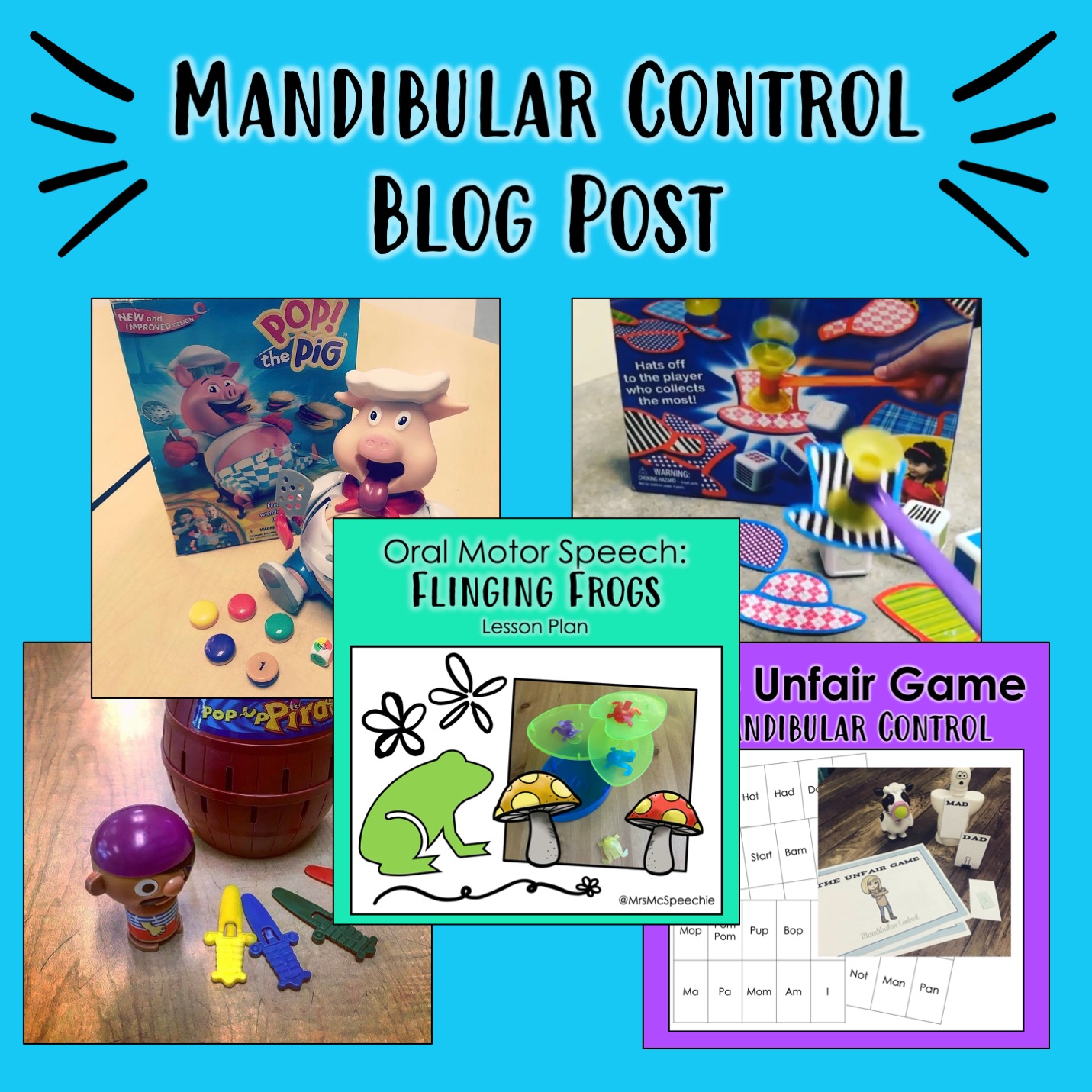
Flinging Frogs

I created this FREE LESSON for my PROMPT technique practicum. This lesson plan contains lexicon for: mandibular control: establishing lower jaw boundary at height four and maintaining midline during excursion. This lesson plan includes: phonemes/lexicon/phrases, game set up and explanations.

Words/Phrases: put, on, me hop, top, pad, he, in, “Put in”, “Put on”, “Oh-no”, “He hop”, “On Pad”, “On top”, “He hop on”, “One, two, hop”


Hit the Hat

This was originally a game geared towards Occupational Therapy. The hammers have suctions cups and the hats are different shapes, patterns with blue or red borders. Roll the three dice and be the first player to locate the correct hat. 


Word/Phrases: hat, hit, did, it, hit the hat, I did it


Pop up Anything

Pop Up Pirate, Pop the Pig, Jumping Jack Rabbit...anything that can go "POP". I'll spare you the "how to play" and get right to the goodies:

Pop the Pig:

Phonatory control: ah, mmm

Mandibular control: not, pop, hat, top

Labial-Facial control: eat, do, two, feed/fed, him, push

Lingual control: it, in did, head

Sequenced movements: hamburger


Pop Up Pirate:

Phonatory control: ah for in, mmm for more

Mandibular control: pop, up, not, oh-man, put in, top, ah/out, Ned

Labial-Facial control: pop, up, man, top, Pete


Unfair Game

The unfair game is a simple game. Points are awarded on the back of the card, positive and negative. This activity can be paired with a nerf popper, listening room activity, bowling or used alone.

Check out the pre-made cards I made found here on TPT.


Sunday, April 11, 2021

Phonatory Control


Building phonatory control in students is an important foundation. Students learn that "voice is power" through simple lexicons:

/AH/ for "on", "want" (turning the voice on)

/M/ for "more" or "me"

/H/ volitional voicing


Activities that have a high success rate for my students and building volitional voicing include:

Belefun

Belefun is Elefun's Younger Sister. Turn the game on and watch the butterflies come out. Feed the butterflies to Belefun for continual fun.

Lexicon: /ah/ for "on", "want", "out", "in", /mmm/ feeding, "more", "me"


Scarves

Scarves are a great way to add movement to your session during music during music or interactive book. Have students wave them left to right, make waves, squish the scarf, move it fast and slow. 

Students can track the scarf to incorporate head tipping/turning into the session to activate their vestibular systems.

Read the beloved story "Going on a Bear Hunt" by Michael Rosen and follow directions using scarves or cloth like items. Great for engaging pre-school
Grab my FREEBIE to incorporate scarves functionally into a story activity to promote focus and attention during academic tasks.

Students will:
-Cross midline
-Track items with head tips/tilts
-Track items with eyes to decrease eye fatigue due to screen time
-Recall the sequence of events
-Follow directions


Spin it Again

Put gears on a pole and watch them spin down. Pull the pole from the base and watch the gears spin off to the ground. Flip blue base to choose a wobbly or sturdy bottom. 

Can be used for simple motor phoneme warm-up. 

PROMPT Lexicon: ah/on, up, go, me


Tunnel

Tunnels can be motivating and regulating at the same time. Students can: 

-Crawl through to retrieve desired items from inside
-Stand and wear it like a pop up hamper
-Roll balls through to have a pass


Yoga Ball

"What happens at the hips, affects the lips" the great PROMPT instructor Tracey Kellner.

When working with non/low verbal kids I try to get them moving as much as possible. Consult with the OT/PT and see what they do with the student. 


-Bounce on a ball
-Roll over the ball (on belly/on back)
-Scooter
-Swing
-Gentle spinning (pick them up or in a chair)
-Crawling through a tunnel
-Animal walks

Friday, February 26, 2021

Appy Hour

Toca Boo

The power is out at Bonnie's house due to a terrible storm. Help her move through the house and scare her family! Explore different rooms, turn sinks and lights on and off to build suspense and even stop to snack on plums, spicy pepper and soda to fuel your fun!

-Map skills

-Following directions

-WH questions

-Oral motor practice (pa/pop, ma/mom/mama, boo, pop up, toot, go, baby, down, in, behind, under, Bonnie, sisters, brother, grandma, grandpa)


*Check out the print companion and Boomcard companion I made for this game*


Toca Kitchen 2

Cook up some fun in your speech sessions with this app. Help feed the hungry customers by preparing different foods. 

-Following Directions

-Make sentences

-Pronouns

-Commenting Like/Dislike

-Oral Motor words/phrases to use (ah/mmm, uh-oh, ya/yes, no, hot, pot, pan, not, can, eat, gone, make, done, eat it, can cut it, can eat it)


*My students enjoy using the hard print items and Boomcard companions I made for this app*


Pet Doctor

Take care of all the pets in the office, feed them and put them to bed.

-Discuss cause/effect

-Identify body parts/injuries/doctor equipment

-Commenting

-Oral Motor practice (oh no/uh oh, boo-boo, go home, eat it, put it on)


Pair the app with a simple matching activity (I found this one years ago at the Target dollar spot) or Henning Lohlein's "All Better Book". 

I incorporate additional fine motor skill work by playing "save the animals", where they are trapped in rubber bands. 

-Take the rubber bands off

-Clean the animals with a spray bottle

-Place tape or real band-aides on the injury


Toca Doctor

Help the patient with all their injuries.

-Cause/Effect

-Inferencing (How did they get hurt?)

-Body parts/labeling

-Health/Wellness

-Oral Motor practice (boo boo, uh-oh, put it on, take it out, help, all done)


Toca Store

Open the store and choose the items you want to sell. Students can take turns being the cashier and the customer.

Describe categories & functions of items

Expand vocabulary

Social communication/turn taking

Oral Motor practice (I want, I choose, put it in, need it)


*Pair with companion boomcard activity for additional support/practice*

Zoombinis

Use logic, analyze data, spot patterns and hone problem-solving skills with 12 perilous puzzles and four levels of difficulty. Great for upper elementary, middle school and high school students. 

-Intro video (wh questions, story comprehension)

-Problem solving

-Teamwork

-Identify details

-Follow directions

-Express ideas 

*For iPad only, you won't be able to find it if you search on your phone*


Sunday, February 7, 2021

Listening and Attentional Supports

Students are frequently referred for a speech and language screening due to teacher reports that "they just don't listen."

Ruling out any hearing loss, behavioral issues and true language challenges, let's discuss why this is most likely not the case. Our vestibular systems are responsible for providing our brain with information about motion, head position, spatial orientation and motor functions such as balance and head stabilization. The eyes and the ears are connected, do you turn down the radio when you're lost?!

Academic tasks that require moving eyes and coordination can manifest as attentional symptoms, therefore look like a student "just can't listen" when in reality they're having difficulty focusing with their eyes.

  • Visual Fixations: sustained focus
  • Tracking: following a moving object
  • Con/Divergence: shifting gaze from teacher to work
  • Quick Localization: visual attention shifts in space to monitor
  • Saccades: attentional shifts needed to read/monitor

When a student is having difficulty using their eyes they will start to utilize other parts of their body. Eye strain/fatigue will bring in the use of their head/neck/back, and cause postural deficits. Resource allocation means that they are on output NOT input, which is essential for absorbing information for academic tasks. 

There are plenty of simple activities to incorporate into your speech and language sessions to support visual skills:

Eye Found it

The 6 foot board game is a collaborative style game where players work together to all reach the castle before the clock strikes midnight. Students can follow directions, target vocabulary (I use the Expanding Expressions Tool (EET) to describe the items on the card) and answer WH questions. 

The compact card game is a fast pace competitive search and find activity. Students race to see who can find the objects on their cards. When the object is found, a new card is flipped and play continues. 

PROMPT Lexicon: I see it, I did it, I am, me, I do, character names (Pooh, Woody...), Counting numbers


Hiding Break

Fighting eye fatigue after many hours of screen time can help regulate students (and teachers!)

Students can use their hands or cover themselves in a blanket. Keeping eyes open and staring into the blackness will bring better benefit for eye fatigue.


*IMPORTANT: Make sure students wash their hands prior to putting them over their eyes.


Hit the Hat

The hammers have suction cups and the hats are different shapes, patterns with blue or red borders. Students roll the dice and race to locate the correct hat. Game can be modified to eliminate boarder color for more winners. Students can take turns rolling the dice and describing the hats for others to find.

PROMPT Lexicon: hat, hit, did, it


Track Slow Objects

Use bubbles, balloons or juggling scarves in sessions to support visual and language needs.

Keepy Uppy: Have students tap a balloon to keep it up in the air

Bubble Pop: weighted wand for popping bubbles slowly (duct tape a small weight to the end of a stick)

Throw and catch juggling scarves

PROMPT Lexicon: /ah/ (want, exclaim excitement, again), /mm/ (more, me), bop, pop, go, oh-no


Vision Boost

Every 20 minutes, look at something 20 feet away for 20 seconds to keep your eyes healthy. A vision boost is an easy way to accomplish this task.

One arm straight, one arm bent and shift your eye gaze (ONLY your eyes, no moving your head) from near to far points 20 times and then switch your hands and do another 20 looks.