Showing posts with label language. Show all posts

Friday, February 26, 2021

Appy Hour

Toca Boo

The power is out at Bonnie's house due to a terrible storm. Help her move through the house and scare her family! Explore different rooms, turn sinks and lights on and off to build suspense and even stop to snack on plums, spicy pepper and soda to fuel your fun!

-Map skills

-Following directions

-WH questions

-Oral motor practice (pa/pop, ma/mom/mama, boo, pop up, toot, go, baby, down, in, behind, under, Bonnie, sisters, brother, grandma, grandpa)


*Check out the print companion and Boomcard companion I made for this game*


Toca Kitchen 2

Cook up some fun in your speech sessions with this app. Help feed the hungry customers by preparing different foods. 

-Following Directions

-Make sentences

-Pronouns

-Commenting Like/Dislike

-Oral Motor words/phrases to use (ah/mmm, uh-oh, ya/yes, no, hot, pot, pan, not, can, eat, gone, make, done, eat it, can cut it, can eat it)


*My students enjoy using the hard print items and Boomcard companions I made for this app*


Pet Doctor

Take care of all the pets in the office, feed them and put them to bed.

-Discuss cause/effect

-Identify body parts/injuries/doctor equipment

-Commenting

-Oral Motor practice (oh no/uh oh, boo-boo, go home, eat it, put it on)


Pair the app with a simple matching activity (I found this one years ago at the Target dollar spot) or Henning Lohlein's "All Better Book". 

I incorporate additional fine motor skill work by playing "save the animals", where they are trapped in rubber bands. 

-Take the rubber bands off

-Clean the animals with a spray bottle

-Place tape or real band-aides on the injury


Toca Doctor

Help the patient with all their injuries.

-Cause/Effect

-Inferencing (How did they get hurt?)

-Body parts/labeling

-Health/Wellness

-Oral Motor practice (boo boo, uh-oh, put it on, take it out, help, all done)


Toca Store

Open the store and choose the items you want to sell. Students can take turns being the cashier and the customer.

Describe categories & functions of items

Expand vocabulary

Social communication/turn taking

Oral Motor practice (I want, I choose, put it in, need it)


*Pair with companion boomcard activity for additional support/practice*

Zoombinis

Use logic, analyze data, spot patterns and hone problem-solving skills with 12 perilous puzzles and four levels of difficulty. Great for upper elementary, middle school and high school students. 

-Intro video (wh questions, story comprehension)

-Problem solving

-Teamwork

-Identify details

-Follow directions

-Express ideas 

*For iPad only, you won't be able to find it if you search on your phone*


Sunday, February 7, 2021

Listening and Attentional Supports

Students are frequently referred for a speech and language screening due to teacher reports that "they just don't listen."

Ruling out any hearing loss, behavioral issues and true language challenges, let's discuss why this is most likely not the case. Our vestibular systems are responsible for providing our brain with information about motion, head position, spatial orientation and motor functions such as balance and head stabilization. The eyes and the ears are connected, do you turn down the radio when you're lost?!

Academic tasks that require moving eyes and coordination can manifest as attentional symptoms, therefore look like a student "just can't listen" when in reality they're having difficulty focusing with their eyes.

  • Visual Fixations: sustained focus
  • Tracking: following a moving object
  • Con/Divergence: shifting gaze from teacher to work
  • Quick Localization: visual attention shifts in space to monitor
  • Saccades: attentional shifts needed to read/monitor

When a student is having difficulty using their eyes they will start to utilize other parts of their body. Eye strain/fatigue will bring in the use of their head/neck/back, and cause postural deficits. Resource allocation means that they are on output NOT input, which is essential for absorbing information for academic tasks. 

There are plenty of simple activities to incorporate into your speech and language sessions to support visual skills:

Eye Found it

The 6 foot board game is a collaborative style game where players work together to all reach the castle before the clock strikes midnight. Students can follow directions, target vocabulary (I use the Expanding Expressions Tool (EET) to describe the items on the card) and answer WH questions. 

The compact card game is a fast pace competitive search and find activity. Students race to see who can find the objects on their cards. When the object is found, a new card is flipped and play continues. 

PROMPT Lexicon: I see it, I did it, I am, me, I do, character names (Pooh, Woody...), Counting numbers


Hiding Break

Fighting eye fatigue after many hours of screen time can help regulate students (and teachers!)

Students can use their hands or cover themselves in a blanket. Keeping eyes open and staring into the blackness will bring better benefit for eye fatigue.


*IMPORTANT: Make sure students wash their hands prior to putting them over their eyes.


Hit the Hat

The hammers have suction cups and the hats are different shapes, patterns with blue or red borders. Students roll the dice and race to locate the correct hat. Game can be modified to eliminate boarder color for more winners. Students can take turns rolling the dice and describing the hats for others to find.

PROMPT Lexicon: hat, hit, did, it


Track Slow Objects

Use bubbles, balloons or juggling scarves in sessions to support visual and language needs.

Keepy Uppy: Have students tap a balloon to keep it up in the air

Bubble Pop: weighted wand for popping bubbles slowly (duct tape a small weight to the end of a stick)

Throw and catch juggling scarves

PROMPT Lexicon: /ah/ (want, exclaim excitement, again), /mm/ (more, me), bop, pop, go, oh-no


Vision Boost

Every 20 minutes, look at something 20 feet away for 20 seconds to keep your eyes healthy. A vision boost is an easy way to accomplish this task.

One arm straight, one arm bent and shift your eye gaze (ONLY your eyes, no moving your head) from near to far points 20 times and then switch your hands and do another 20 looks. 

Monday, December 21, 2020

Cozy Up with a Great Book


"Young children who heard the same book multiple times retained a new word better than children who were read different books containing the same word."

Numerous studies have shown that storybook reading promotes later academic performance, reading fluency and print knowledge. A study in 2011 by Horst et. al. was the first of its kind to explore how being read to influences young children's ability to learn new words from storybooks. The lack of research in this area is particularly surprising given how frequently young children are read to during their everyday preschool experiences. The study found that repetition of storybooks is important for learning new vocabulary from books. Young children who heard the same book multiple times retained a new word better than children who were read different books containing the same word. 

Reference: Horst, J.S., Parsons, K.L. & Bryan N.M. (2011). Get the story straight: Contextual repetition promotes word learning from storybooks. 

KUDOS to @midtownspeechnyc for this special instagram post, if you're not following along click this link to check her out!

Here are the books I read on repeat for my students during Winter. 


Snowmen at Christmas by Caralyn Buehner

Read the story of what Snowmen do at Christmas.

-Compare/contrast our Christmas traditions to the Snowmen's

-Search for hidden items on every page; mouse, T-Rex, cat, bunny and a Santa face.


*Tip: Searching for hidden pictures is great for visual skills needed for attention, reading and writing!*


Sneezy the Snowman Maureen Wright

Sneezy the snowman enjoys winter fun with his friends, but keeps sneezing!? His friends make attempts to help him warm up, but keep melting him.

Pair the story with the amazing melting snowman, build the snowman and read the story. Watch what happens!

-Sequence

-Cause/Effect

-Categories (things that are hot)

*Tip: I have students discuss items that are hot, and then illustrate a sentence as to why Sneezy may have melted*


The Mitten by Jan Brett

Nikki goes on a winter adventure and loses a snow-white mitten from Baba. Forest animals find the cozy mitten and all squeeze in.

-WH questions

-Sequencing/recall

-Following directions

-Oral motor (put it on, ball, bam/smash, put it in)


*Check out @simply_speech and her FREEBIE smash mat companion*


Falling for Rapunzel by Leah Wilcox

Add this fun story to your Valentine's Day sessions. Rapunzel is too far away to quite make out what the Prince is trying to say. This is a hilarious hit in my speech sessions as we read the story of miscommunication.

-Sequencing/recall

-WH questions

-Rhyming

-Yes/No questions

-Vocabulary

-Create your own story


*Book companion can be found on TPT by SteamPunk Speech*

*Tip: pair this story with card game Sleeping Queens and Lover's Leap found on www.thelisteningroom.com*


Pancakes for Breakfast by Tommie DePaola

National Pancake Day is typically in early March. We celebrate every year in speech with this story and flippin' fun activities. This wordless story is great for any age. Early one morning the lady wakes up and decides to make pancakes, but keeps running into problems. 

-Problem solving

-Create grammatically correct sentences

-Sequencing/retell

-Vocabulary

-Oral motor (she can make it, she needs..., go out)

Saturday, March 2, 2019

The Doctor is in...

Anyone else celebrating Dr. Seuss' birthday?! I love incorporating real world items into our therapy sessions. The students love making a mess, so in honor of the great Dr. Seuss we make "oobleck". We learn about Dr. Seuss and read a short biography, I read a truncated version of "Bartholomew and the Oobleck" by Dr. Seuss (the original takes over 30 minutes for me to get through!?) and then I present them with the science experiment.

Oobleck is a 'non-newtonian fluid'. Viscosity is the rate at which something pours. Water pours quickly and honey or syrup pours slowly. These liquids have a constant viscosity, it will never change. Oobleck pours both quick AND slow!?

When made correctly Oobleck can be molded into a ball and have properties like a solid, and when released will "melt" in your hand like a liquid.

Oobleck is a 2:1 ratio

2 cups cornstartch
1 cup water

TIPS:
*I love to find youtube videos to help the students see what should happen, before starting.
*Use disposable bowls and spoons for easy clean up.
*Buy the rolls of plastic tablecloths to work on, then just throw everything out.
*If the oobleck is too hard add water, and if it is too wet add more corn starch!
*If the oobleck spills over and out, let it dry it will turn into powder and you can easily vacuum/sweep it up!


PROMPT: *I created a short "Bartholomew and the Oobleck" on my SMARTboard, I can change the words/phrases/sentences to achieve my various targets!

LANGUAGE: scientific method, following directions/steps, math fractions

PRAGMATICS: sharing items, turn taking for measuring, following rules


Oo the messes you will make!

Monday, November 23, 2015

Listening Language

Dingle Dangle: Listening and Language! I love this app it is so adorable and silly. There are two different activities: players can listen to instructions (in noise!) or build their own scarecrow.

This app was created by the Royal Institute for Deaf and Blind Children (RIDBC) by listening and spoken language specialists.

I love to pair this app with the story "The Little Old Lady Who Was Not Afraid of Anything". I use this with a lot of my students.

We color and cut out the pieces and make puppets. They have to listen to the sounds of the pieces and make their puppet do the actions

Shoes say "clomp clomp"
Pants say "wiggle wiggle"
Shirt says "shake shake shake"
Hat says "nod"
Gloves say "clap"
Pumpkin says "boo!"


PROMPT:
Phonatory Control: "ah" for on, "mm" for more
Labial-facial control: boo, shake, oh no!
Lingual control/sequenced: clomp, wiggle, clap, nod

LANGUAGE: sequencing, following directions, recall story, describing

      And the mouse went ::click click::


Peek-a-Boo I'm back

Using visuals I can use this for a great listening activity.; for auditory-visual therapy. The animal hiding behind the door makes a sound and the door shakes so it's a good visual for the hearing impaired! Animals include the usual farm friends: horse, cow, sheep, chicken... and some funny new friends: owl, rabbit, llama! From a closed set I show the pictures of the animals and have the child guess which animal they hear in the barn.


I love the Melissa & Doug matching game and pair a simple barn toy to finish our FARM-tastic session.


LANGUAGE: follow directions, prepositions, matching

PROMPT:

Mandibular control: baa
Labial-Facial: boo, moo, peep, woof, meow, baa, me, push
Lingual: one, two


Old McDonald has nothing on me!

"Poppers"

Choose from a variety of animals: cow, horse, pig, fish, alien, squirrel, moose! Push the ball in and aim it at the target *Children need constant supervision...don't let them pop it in their face.

We laugh, we cry, we do a little math! Very fun and entertaining.


PROMPT:
phonatory control: ah, ha, ha-ha, mmm (for more)
mandibular control: up, on, pop
labial-facial control: up, pop, on, moo (is the name of our cow), oh-no, push
lingual control: on, top, in

Language:
-Follow directions to aim at different targets
-Follow directions to pick a special colored ball/animal

Pragmatics:
-Turn taking
-Don't point it at people/yourself!

Don't be a party pooper in speech...play with some "Poppers"

Monday, November 24, 2014

Celebrate November with a Salute

This time of the year many teachers are teaching vocabulary for the big holiday in November. I'd like to take this time to remind you of a very important group that gets forgotten in the hustle and bustle of turkey season...the veterans. I've laid out my November plan in hopes to spread the love to our brave soldiers and of course express my gratitude!

I introduced the topic of Veterans Day with vocabulary: honor, respect, thankful, salute, celebrate, faithful, loyal, serve.


I work in a school for the Deaf and hard of hearing and targeted auditory skills by counting syllables for words from arlenesandberg.blogspot.com:

Words included 1-4 syllables: world, war, peace, wreath, sailor, parade, solider, salute, medal poppy, November, 11th, veterans, memorial, ceremony, military.

I explained what Veteran's Day was and we made flags out of hand prints. Some of the terminology used on the poster is from a pin I found on pinterest (http://www.mylifeasathirdgradeteacher.com/).


November 11th: a day to honor those who have served and are currently serving in the military

What is a Veteran?
-A person who has fought for our country
Navy, Army, Air Force, Marine, Coast Guard

What do they do?
-Protect our country!
-Fight for our freedom!


I used "The Wall" by Eve Bunting and created my own reading comprehension questions based on the student's goals (i.e. main idea, recalling details, sequencing).


My older kids (5th-7th grade) get a kick out of my "Speechgram". We created usernames in the beginning of the year and I post a new picture every week. The kids can ask questions and write (grammatically correct) comments! It's fun to see what the kids come up with, and they are all super motivated to write! This is my friend Bridgett, she is a marine.

#who #what #when #where #why #how


(We are still working on the grammatically correct...and spelling)

Now for my favorite. Writing to Bridgett and her soldier friends. Operation Gratitude is always looking for letters to soldiers! Collaborate with your OT friends for a super fun writing a letter lesson! It was a fun process for the students and they were excited and motivated. I broke down the process into parts and really drilled ASKING and ANSWERING questions. I created statements (i.e. "My favorite movie is Frozen.") and had the students create their own questions; What's your favorite movie? Who is your favorite character? Again, since I'm in a school where Auditory Verbal is a big component of speech; I asked questions presented orally only and incorporated it into this part of the lesson.

It was an easy way to transition into Thanksgiving; as we were all feeling very thankful for the brave men and women in the military.


THANKS for reading.

Friday, April 25, 2014

Heads Up...I'm back!


After a long hiatus, I'm back. Hoping to connect with some parents to help them chose and use apps and activities for speech therapy!

So, this is one of my new FAVORITE games. Of all time. Ever! 

Ellen DeGeneres is a DeGenuis! A simple "Heads-bands" type game, keeps kids and adults entertained while working on various speech goals.

Players can pick various categories (I use "just for kids", cause there's a smattering of everything: people/places/things). Place the iPhone/iPad on your head and the other players describe the item! If you are able to guess correctly turn the iDevice down, if you are having trouble you may pass it by turning the iDevice up/over your head.


LANGUAGE:
Expressive: adjectives, describing, antonyms, synonyms, using word finding strategies
Receptive: (understanding all the above!), word finding strategies, follow directions
*Follow directions/understanding figurative language: I always use the phrase "It's over your head" (you don't get it) to explain the correct/pass rules. 

PRAGMATICS:
turn taking, controlling voice volume & remaining in your seat (things can get crazy!)


Just keep playing. Just keep playing.

Tuesday, June 25, 2013

It looked like just another mundane post...but it wasn't another mundane post!


This is a great and simple activity for identifying simple objects (some doozies in it "Great Horned Owl", "Angel"). After you read the book you can make your own spilt milk clouds!


Squeeze paint in the middle of the page (*I added sparkles for something special*), fold the page in half, press down and open.

I looked like a sheep....but it wasn't a sheep!

PROMPT:
*Use a carrier phrase "It looked like a ______, but was it?!" the child can respond "No"

Language:
Sequence, answer simple "WH" questions

Don't Let this post get by....

Mo Willems has done it, time and time again! Author and illustrator of the "Don't let the Pigeon Drive the Bus" (caldecott honor) and many others.

I love this interactive book.  My kids love to yell "NO!" when the pigeon asks to drive the bus.  My strong willed preschoolers occasionally are swayed when the pigeon offers them $5 bucks...but are easily redirected when reminded, "The bus driver said, don't let the pigeon drive the bus!" They then enthusiastically yell, "NO!"

**Hello labial-facial control!**

Best yet, there's an app for that! "Don't let the pigeon run this app".  This allows the user to create their very own pigeon story! The "chick" makes up a different story every use, "little pigeon" allows the user to choose different items from a field of three and "big pigeon" allows the user to answer questions using their own words/voice!  The author Mo Willems even teaches you to draw the pigeon in a step-by-step!

PROMPT:
Labial-Facial control: no, mo

Language:
Answer "Wh" questions, simple sequence


Don't let this book and app pass you by!

Thursday, May 30, 2013

Hungry for Summer!


Here's a few activities that keep my clients compliant and engaged throughout the entire session! Read the book, make some art and of course play on the iPad!

READ THE BOOK:
I've been on a "Hungry Caterpillar" kick!  First I read the story to my clients and tell them they will read the story.  All my Pre-Schoolers tell me, "But I can't read!" I assure them they can!  Then using felt pieces I made (A.C. Moore sells iron on paper! I just scan and iron onto white felt) my clients "read" the story.  It's great to see how proud they are when they finish and I get to tell them they read the story!

*Leave a comment with your e-mail address and I can send you a copy of the pieces so you don't have to scan!*

ART PROJECT:
A fun companion activity we do after is we make our own symmetrical butterflies.  Using scented dot markers (Wal-mart!) we make dots and designs and fold our paper in half to make symmetrical designs.  The kids think it's neat, I love the dot markers cause they don't make a mess and we get to explore some sensory integration with smell!
*Remember those great markers your elementary art teacher let you use! Check out all their products*


INCORPORATE THE BELOVED iPAD:
I was able to grab this app during a free app sensational sale (Check it out)! I have my kids follow directions and practice counting!


ARTICULATION
need, dot, more, me, same, mmmm, one, two
Mandibular control: dot, need
Labial-Facial control: more, me, same, mmmm
Lingual control: one, two


LANGUAGE
sequence; first/next/then/last, labeling (food items), counting, answering/asking "WH?", predicting ("What do you think yellow will smell like?"), follow directions


Smell ya later!

Tuesday, May 7, 2013

Make your own bubbles

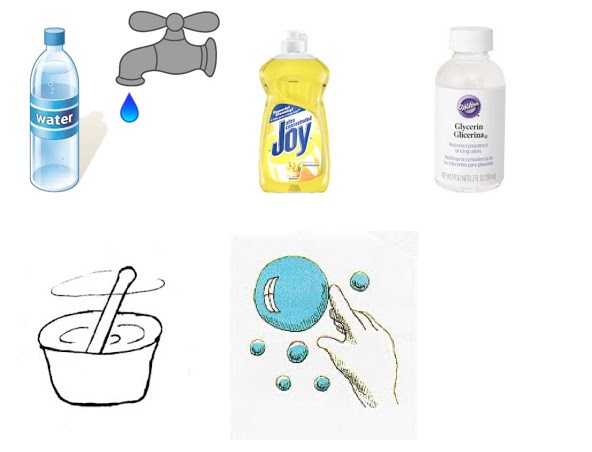
Sunny days are ahead. My clients and I have been enjoying the weather during our sessions.  One of my new favorite activities is making bubbles.  That's right 4 easy steps to mixing up your very own bubble solution. I have included the recipe below, however I just estimate and add soap/glycerin until the solution is making bubbles that last.

1 gallon of water
2/3 cup of Dawn or Joy dishwashing liquid (Joy works better)
3 to 4 table spoons of glycerin (available at drugstores)
stir
*ta-da!* 
(recipe courtesy of Newsday 7/27/11)


PROMPT: labial-facial, mandibular, lingual control
pop, more, oh-no, gone, wand

LANGUAGE: sequence (cut out pictures above to make cards), WH? questions, requests, action words (stir/mix, pop, run, reach)

PRAGMATICS: turn-taking


Have a towel handy, things can get messy! 
(But not dirty, cause it's soap!)

Tuesday, April 9, 2013

APP-Y HOUR: Bubbles

Bubbles (.99 cents)

Totally worth the money. I have used this app for EVERYTHING! I use this app with children who are unfamiliar with the iPad.  I have had a lot of success with teaching skills used, such as drag/tap with the appropriate pressure.

Reinforcement (earn the game)
**Teach pre-iPad skills (drag and tap with the appropriate amount of force/pressure)

Articulation: (labial facial control, mandibular control, lingual control)
         -"Pop" 
         -"More" 
         -"oh-no", "uh-oh"
        -"Me"
Language:
         -Turn taking (You make bubbles, I make bubbles)
         -Requests (More bubbles please!)
         -WH?


Pop-on friends.


Monday, March 25, 2013

APP-Y HOUR: Glowcoloring

Glowcoloring

I love to use this with one of my school aged clients.  We practice writing spelling words, and she loves to pick a color to write in (one only, otherwise we would be picking colors ALL day!)

This is a great app not only for free-hand drawing, but for coloring/worksheets! Yes. You can import any picture from your photo album and bam! Boring old sheet because super fun and exciting with colors and stamps.  I use Dropbox to store all my exciting papers.

What are you waiting for. "Glow" and download it!


Sunday, March 17, 2013

APP-Y HOUR: Questionit

Questionit (LITE/$24.99)

Users answer: who, what doing, where, when questions.  There are different areas to answer these questions: sorting, sentences (basic/advanced) and paragraphs.    Within the areas there are 3 levels.  Level (1) is easy and color coded for easier sorting, Level (2) is medium as only the borders are color coded and Level (3) is the hardest with no color hint.

I have used this with various students (preschool, school aged, adolescent and even adults!) The school aged students don't even know they're learning "WH" questions and categorization skills! We are able to learn and have fun.


Can you believe they pay me to have fun?!


Monday, March 11, 2013

APP-Y HOUR: Sparklefish

SparkleFish (FREE!)

I know you're thinking, "What is that scary fish from Disney's Finding Nemo doing on a children's app?!" And why does he look like he's got a disco ball on his head? Is he trying to lure John Travolta instead of Marlin and Dory? (Disco ball look-alike is actually a microphone).

Sparkle Fish is an interactive mad libs!  Choose a story to create.  The user is provided with a list of 10 mixed vocabulary (adjective, noun, verb, adverb, etc.).  Record your answers and "Sparkle Fish it".  The app inserts the vocabulary into the story to create a silly tale, that's never the same!


Just keep swimming. pinning. blogging. whatever.