Showing posts with label distancelearning. Show all posts

Friday, February 26, 2021

Appy Hour

Toca Boo

The power is out at Bonnie's house due to a terrible storm. Help her move through the house and scare her family! Explore different rooms, turn sinks and lights on and off to build suspense and even stop to snack on plums, spicy pepper and soda to fuel your fun!

-Map skills

-Following directions

-WH questions

-Oral motor practice (pa/pop, ma/mom/mama, boo, pop up, toot, go, baby, down, in, behind, under, Bonnie, sisters, brother, grandma, grandpa)


*Check out the print companion and Boomcard companion I made for this game*


Toca Kitchen 2

Cook up some fun in your speech sessions with this app. Help feed the hungry customers by preparing different foods. 

-Following Directions

-Make sentences

-Pronouns

-Commenting Like/Dislike

-Oral Motor words/phrases to use (ah/mmm, uh-oh, ya/yes, no, hot, pot, pan, not, can, eat, gone, make, done, eat it, can cut it, can eat it)


*My students enjoy using the hard print items and Boomcard companions I made for this app*


Pet Doctor

Take care of all the pets in the office, feed them and put them to bed.

-Discuss cause/effect

-Identify body parts/injuries/doctor equipment

-Commenting

-Oral Motor practice (oh no/uh oh, boo-boo, go home, eat it, put it on)


Pair the app with a simple matching activity (I found this one years ago at the Target dollar spot) or Henning Lohlein's "All Better Book". 

I incorporate additional fine motor skill work by playing "save the animals", where they are trapped in rubber bands. 

-Take the rubber bands off

-Clean the animals with a spray bottle

-Place tape or real band-aides on the injury


Toca Doctor

Help the patient with all their injuries.

-Cause/Effect

-Inferencing (How did they get hurt?)

-Body parts/labeling

-Health/Wellness

-Oral Motor practice (boo boo, uh-oh, put it on, take it out, help, all done)


Toca Store

Open the store and choose the items you want to sell. Students can take turns being the cashier and the customer.

Describe categories & functions of items

Expand vocabulary

Social communication/turn taking

Oral Motor practice (I want, I choose, put it in, need it)


*Pair with companion boomcard activity for additional support/practice*

Zoombinis

Use logic, analyze data, spot patterns and hone problem-solving skills with 12 perilous puzzles and four levels of difficulty. Great for upper elementary, middle school and high school students. 

-Intro video (wh questions, story comprehension)

-Problem solving

-Teamwork

-Identify details

-Follow directions

-Express ideas 

*For iPad only, you won't be able to find it if you search on your phone*


Sunday, February 7, 2021

Listening and Attentional Supports

Students are frequently referred for a speech and language screening due to teacher reports that "they just don't listen."

Ruling out any hearing loss, behavioral issues and true language challenges, let's discuss why this is most likely not the case. Our vestibular systems are responsible for providing our brain with information about motion, head position, spatial orientation and motor functions such as balance and head stabilization. The eyes and the ears are connected, do you turn down the radio when you're lost?!

Academic tasks that require moving eyes and coordination can manifest as attentional symptoms, therefore look like a student "just can't listen" when in reality they're having difficulty focusing with their eyes.

  • Visual Fixations: sustained focus
  • Tracking: following a moving object
  • Con/Divergence: shifting gaze from teacher to work
  • Quick Localization: visual attention shifts in space to monitor
  • Saccades: attentional shifts needed to read/monitor

When a student is having difficulty using their eyes they will start to utilize other parts of their body. Eye strain/fatigue will bring in the use of their head/neck/back, and cause postural deficits. Resource allocation means that they are on output NOT input, which is essential for absorbing information for academic tasks. 

There are plenty of simple activities to incorporate into your speech and language sessions to support visual skills:

Eye Found it

The 6 foot board game is a collaborative style game where players work together to all reach the castle before the clock strikes midnight. Students can follow directions, target vocabulary (I use the Expanding Expressions Tool (EET) to describe the items on the card) and answer WH questions. 

The compact card game is a fast pace competitive search and find activity. Students race to see who can find the objects on their cards. When the object is found, a new card is flipped and play continues. 

PROMPT Lexicon: I see it, I did it, I am, me, I do, character names (Pooh, Woody...), Counting numbers


Hiding Break

Fighting eye fatigue after many hours of screen time can help regulate students (and teachers!)

Students can use their hands or cover themselves in a blanket. Keeping eyes open and staring into the blackness will bring better benefit for eye fatigue.


*IMPORTANT: Make sure students wash their hands prior to putting them over their eyes.


Hit the Hat

The hammers have suction cups and the hats are different shapes, patterns with blue or red borders. Students roll the dice and race to locate the correct hat. Game can be modified to eliminate boarder color for more winners. Students can take turns rolling the dice and describing the hats for others to find.

PROMPT Lexicon: hat, hit, did, it


Track Slow Objects

Use bubbles, balloons or juggling scarves in sessions to support visual and language needs.

Keepy Uppy: Have students tap a balloon to keep it up in the air

Bubble Pop: weighted wand for popping bubbles slowly (duct tape a small weight to the end of a stick)

Throw and catch juggling scarves

PROMPT Lexicon: /ah/ (want, exclaim excitement, again), /mm/ (more, me), bop, pop, go, oh-no


Vision Boost

Every 20 minutes, look at something 20 feet away for 20 seconds to keep your eyes healthy. A vision boost is an easy way to accomplish this task.

One arm straight, one arm bent and shift your eye gaze (ONLY your eyes, no moving your head) from near to far points 20 times and then switch your hands and do another 20 looks. 

Monday, December 21, 2020

Cozy Up with a Great Book


"Young children who heard the same book multiple times retained a new word better than children who were read different books containing the same word."

Numerous studies have shown that storybook reading promotes later academic performance, reading fluency and print knowledge. A study in 2011 by Horst et. al. was the first of its kind to explore how being read to influences young children's ability to learn new words from storybooks. The lack of research in this area is particularly surprising given how frequently young children are read to during their everyday preschool experiences. The study found that repetition of storybooks is important for learning new vocabulary from books. Young children who heard the same book multiple times retained a new word better than children who were read different books containing the same word. 

Reference: Horst, J.S., Parsons, K.L. & Bryan N.M. (2011). Get the story straight: Contextual repetition promotes word learning from storybooks. 

KUDOS to @midtownspeechnyc for this special instagram post, if you're not following along click this link to check her out!

Here are the books I read on repeat for my students during Winter. 


Snowmen at Christmas by Caralyn Buehner

Read the story of what Snowmen do at Christmas.

-Compare/contrast our Christmas traditions to the Snowmen's

-Search for hidden items on every page; mouse, T-Rex, cat, bunny and a Santa face.


*Tip: Searching for hidden pictures is great for visual skills needed for attention, reading and writing!*


Sneezy the Snowman Maureen Wright

Sneezy the snowman enjoys winter fun with his friends, but keeps sneezing!? His friends make attempts to help him warm up, but keep melting him.

Pair the story with the amazing melting snowman, build the snowman and read the story. Watch what happens!

-Sequence

-Cause/Effect

-Categories (things that are hot)

*Tip: I have students discuss items that are hot, and then illustrate a sentence as to why Sneezy may have melted*


The Mitten by Jan Brett

Nikki goes on a winter adventure and loses a snow-white mitten from Baba. Forest animals find the cozy mitten and all squeeze in.

-WH questions

-Sequencing/recall

-Following directions

-Oral motor (put it on, ball, bam/smash, put it in)


*Check out @simply_speech and her FREEBIE smash mat companion*


Falling for Rapunzel by Leah Wilcox

Add this fun story to your Valentine's Day sessions. Rapunzel is too far away to quite make out what the Prince is trying to say. This is a hilarious hit in my speech sessions as we read the story of miscommunication.

-Sequencing/recall

-WH questions

-Rhyming

-Yes/No questions

-Vocabulary

-Create your own story


*Book companion can be found on TPT by SteamPunk Speech*

*Tip: pair this story with card game Sleeping Queens and Lover's Leap found on www.thelisteningroom.com*


Pancakes for Breakfast by Tommie DePaola

National Pancake Day is typically in early March. We celebrate every year in speech with this story and flippin' fun activities. This wordless story is great for any age. Early one morning the lady wakes up and decides to make pancakes, but keeps running into problems. 

-Problem solving

-Create grammatically correct sentences

-Sequencing/retell

-Vocabulary

-Oral motor (she can make it, she needs..., go out)

Sunday, November 1, 2020

Bon Appetit: Toca Kitchen 2 app companion BUNDLE


This product is useful to target various speech, listening and language goals during sessions. Students can follow simple and complex directions, work on expressive and receptive language skills via pronouns, commenting, identifying food items as well as target activities for daily living by sequencing orders through cooking. 

This product includes 

-45 WHO questions
-20 WHAT questions
-32 HOW questions
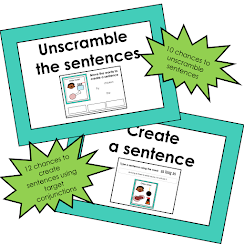
-22 opportunities to make grammatically correct sentences
     10 unscrambling sentences
     12 create your own with target conjunctions
-22 items to describe
     6 pre-teaching slides
     10 Level 1 sorting descriptions
     12 Level 2 fill-in descriptions

**Click on the pictures to see a preview of the items**


Find this product on
  TPT
and